
Every year, millions of dollars in cargo nets, tie-down straps, and specialized temperature-control barriers vanish across the global ramp ecosystem. The primary weak link is fragmented handoffs and lost paper UCR forms. ULDigital and the e-UCR app close the loop on accessory recovery through two secure digital verification pathways: Option A (RFID + e-UCR) and Option B (Non-RFID + e-UCR). Option A utilizes writeable RFID tags embedded directly into aluminum pallet toe-rails to register accessory counts digitally upon transfer. Option B utilizes mobile OCR scanning to capture the pallet’s ULD ID number instantly and log accessory quantities via the digital e-UCR interface. Both pathways record precise GPS coordinates of the mobile device at the moment of transaction to establish clear custody.
- #AviationLogistics #ULDAviation #CargoOperations #DigitalTransformation #eUCR #AirCargo
Executive Brief
In the air cargo industry, Unit Load Devices (ULDs) are recognized as flight-essential safety equipment, but accessories that secure and protect cargo—such as heavy-duty pallet nets, lashing straps, corner protectors, and specialized thermal barriers—are treated as consumables. This operational oversight costs airlines and ground handling agents (GHAs) millions of dollars annually in unrecovered assets. The historical transfer of liability has relied on a manual paper UCR (ULD Control Receipt) process. These paper slips are routinely lost, water-damaged, or completely ignored during fast-paced station handoffs, leaving carriers with zero visibility or recourse when accessories fail to return. By implementing the digital e-UCR mobile app and its secure eVerify protocol, airlines can establish an ironclad digital audit trail for every net, strap, and accessory, directly tying them to the pallet’s ULD ID number at the point of custody transfer.
Ramp Reality & Operational Context
The air cargo ramp is a chaotic, high-pressure environment. When flat aluminum aircraft ULD cargo pallets (such as standard PMC plates) arrive at a consignee’s or ground handler’s facility, cargo is stripped rapidly. During this breakdown process, high-value accessories like double-stud lashing straps and custom cargo nets are tossed into random piles or retained by third parties for their own operational use.
Because permanent identification markings on aluminum pallet frames are frequently worn down or obscured by dirt and grease, ramp handlers struggle to track specific assets. Legacy paper-based handoffs offer no protection: handlers do not have the time to manually write down accessories, nor is there a reliable mechanism to prove when or where a transfer occurred. Without a digital signature, the receiving party has no accountability, resulting in an endless cycle of replacement purchases for the airline. The e-UCR app resolves this by recording the exact GPS coordinates of the handling agent’s mobile device at the precise moment of digital signing, eliminating disputes over where assets were transferred or left behind.
Solution Architecture
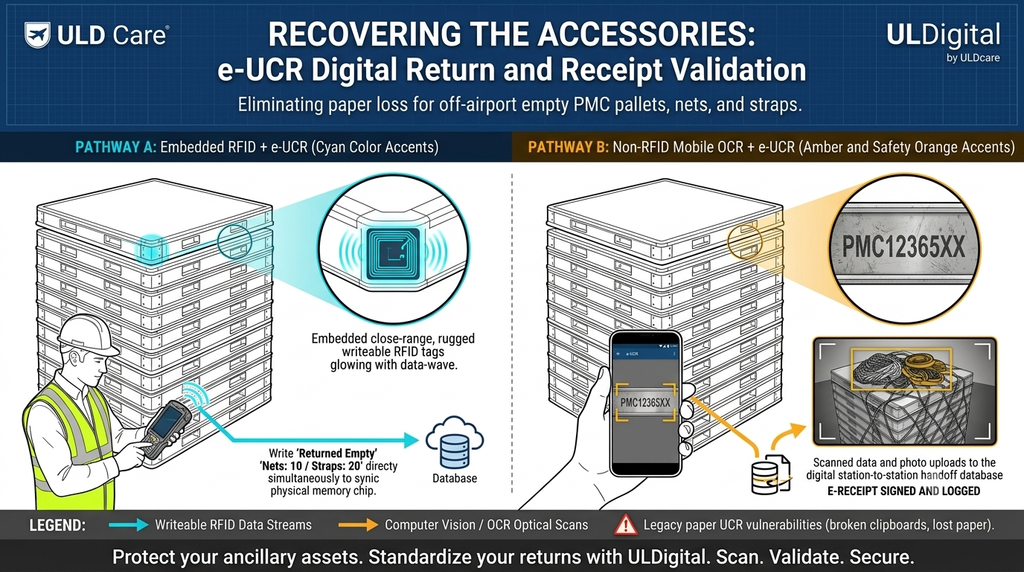
Option A — Writeable In-Rail RFID + e-UCR
This hardware-enabled path integrates passive, close-range writeable RFID tags directly within the protected channel of the flat aluminum pallet’s toe-rails and the e-UCR app to record the transaction to the ULD Care Cloud.
- Digital Custody Transfer: The receiving agent scans the toe-rail tag to verify the physical inventory matches the digital manifest. The e-UCR app executes the eVerify function, logging the digital signature and capturing the device’s real-time GPS coordinates at the moment of the transaction. This data syncs automatically with the airline’s centralized cloud database.ed path integrates passive, close-range writeable RFID tags directly within the protected channel of the flat aluminum pallet’s toe-rails.
- Tag Provisioning: The pallet’s ULD ID number is permanently written to the embedded In-rail RFID tag.
- Accessory Logging: Upon cargo breakdown or handoff, the ground handler uses an RFID-enabled mobile device running the e-UCR app to scan the In-rail tag.
- Write Capability: The handler inputs the number of straps, nets, or thermal covers being returned or transferred. The e-UCR app writes this accessory manifest directly to the In-rail RFID tag, physically linking the accessory data to the pallet itself.
- Instant Validation: The handler reviews the digital UCR summary on screen.
- Digital eVerify Transfer: The handoff partner signs directly on the mobile screen. The e-UCR app registers the transaction, automatically locking in the GPS location metadata of the mobile device to confirm the exact transfer point. The validated e-UCR is immediately routed to both parties’ digital systems, completing the return loop without physical tags required on accessories.
Solution Option B — e-UCR Verification
For stations operating without RFID infrastructure, this software-only path leverages the e-UCR app on standard mobile devices to deliver identical accountability.
- OCR Scan of Permanent ULD ID: The ground handler opens the e-UCR app and uses the smartphone camera to perform an Optical Character Recognition (OCR) text scan of the pallet’s standard IATA ULD ID number permanently marked on the corner of the aluminum frame.
- Manual / BLE Accessory Count: The app prompts the handler to input the specific quantity of accessories accompanying the pallet. Alternatively, if accessories are equipped with generic Bluetooth Low Energy (BLE) proximity beacons, the app auto-populates the inventory.
- Instant Validation: The handler reviews the digital UCR summary on screen.
- Digital eVerify Transfer: The handoff partner signs directly on the mobile screen. The e-UCR app registers the transaction, automatically locking in the GPS location metadata of the mobile device to confirm the exact transfer point. The validated e-UCR is immediately routed to both parties’ digital systems, completing the return loop without physical tags required on accessories.
Financial & Operational Impact Matrix
| Metric / Feature | Option A: Writeable In-Rail RFID + e-UCR | Option B: Non-RFID e-UCR Verification |
| 1. Capital Expenditure (CapEx) | Moderate; requires procurement of ruggedized toe-rail RFID tags and compatible reader devices. | Very Low; utilizes existing mobile devices and standard smartphone cameras. |
| 2. Accessory Recovery Rate | Projected 92–98% recovery; physical data lock on the pallet toe-rail prevents data loss during offline operations. | Projected 80–88% recovery; relies on handler compliance to scan and input data at point of handoff. |
| 3. Processing Speed per ULD | Ultra-Fast (< 3 seconds); instantaneous proximity scan and automated write-to-tag. | Fast (< 10 seconds); rapid OCR scan of the pallet’s ULD ID number with tap-to-verify interface. |
| 4. Operational Offline Resilience | High; accessory data remains physically written to the toe-rail tag even if cellular network coverage is lost. | Moderate; data is stored locally within the e-UCR mobile app and queued for upload when network connectivity returns. |
| 5. Chain of Custody Validation | Absolute; secure hardware-to-app handshake paired with device GPS capture during digital eVerify signature. | High; OCR verification of physical ULD ID number paired with device GPS capture during digital eVerify signature. |
| 6. Integration Overhead | Moderate; requires alignment of RFID data fields with active IoT location tracking networks and ULD systems. | Low; direct API-based integration between the e-UCR platform and third-party ULD management platforms. |