
Executive Summary
Unit Load Devices (ULDs) represent significant capital investments for airlines and air cargo operators. However, when damaged assets transition between carriers, Ground Handling Agents (GHAs), and Maintenance, Repair, and Overhaul (MRO) stations, physical custody tracking frequently breaks down.
Legacy paper ULD Control Receipts (UCRs) are easily lost, damaged, or left unrecorded, leading to liability disputes, extended asset downtime, and airworthiness compliance risks.
The e-UCR mobile app powered by eVerify replaces paper-based handoffs with an audit-ready digital workflow. By capturing accurate transaction timestamps, device GPS coordinates, and asset status updates, eVerify eliminates administrative friction and protects asset utilization. Discover how to modernize your fleet management at https://uldigital.aero/everify/.
The Operational Challenge on the Ramp
Air cargo operational environments place high physical demands on tracking hardware and documentation. Standard paper tags, adhesive shipping labels, and surface-mounted tracking devices cannot withstand ramp conditions, automated handling systems, and metal-to-metal abrasion.
Industry regulations dictate permanent, 10-character alphanumeric IATA markings stamped directly onto ULD frames. Over time, these metal markings become scratched or obscured. When damaged assets arrive at repair facilities without clear documentation, MRO stations face significant administrative delays attempting to identify ownership, verify warranty coverage, or establish baseline airworthiness.
Deployment Pathways
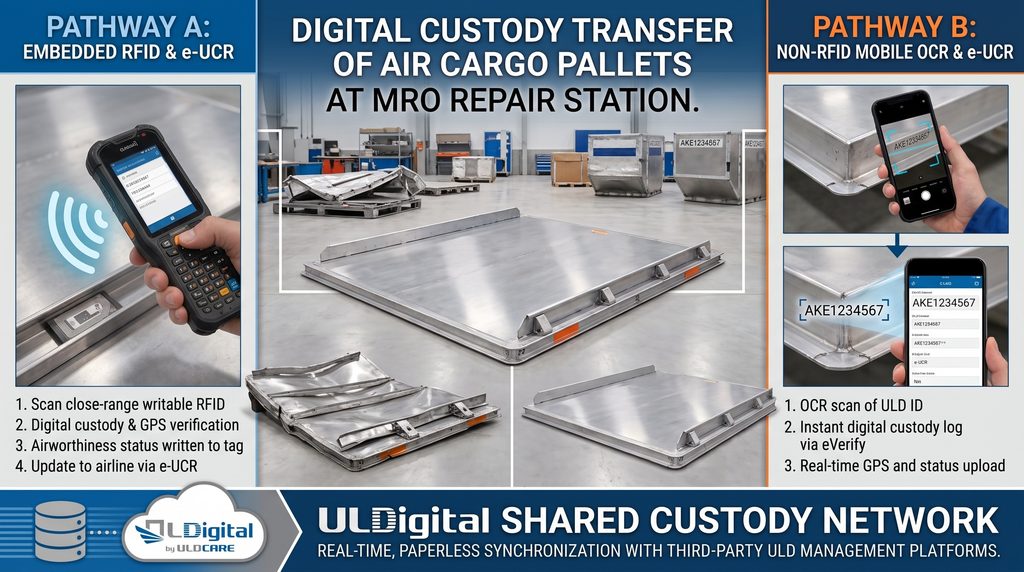
Pathway A: Embedded Writeable RFID + e-UCR
- Hardware Setup: Ultra-durable, passive, writeable RFID tags are installed within the protective toe-rail channels of air cargo PMC’s.
- Induction Workflow: Technicians scan the embedded tag using the e-UCR app on an Android Scanning Sled. The application records the ULD ID alongside transaction-time GPS coordinates.
- Status Sync: The app writes the updated operational status (e.g., “Inducted – MRO Repair” or “Serviceable/Airworthy”) directly to the physical RFID tag while synchronizing the digital record to the cloud.
- Return to Airline: Upon return to the airline the GHA can scan the ULD and ensure the status before putting back into service;
Pathway B: Mobile OCR Scanning (Zero Hardware Footprint)
- Optical Scanning: Technicians point a standard mobile device camera at the ULD Idon the PMC. The integrated OCR engine instantly extracts the ID number adding into the e-UCR app transaction.
- Manual Override Backup: If ULD tag cannot be read by optical reading, technicians can utilize an in-app manual entry.
- Digital Handoff: Selecting the custody action automatically captures GPS coordinates and time data, instantly issuing a digital e-UCR receipt to both the MRO and the carrier.
Operational & Financial Impact
| Impact Area | Measurable Outcome | Key Benefit |
| Dispute Reduction | 95% Reduction | Eliminates liability disputes via timestamped photos and digital custody records. |
| Turnaround Time (TAT) | 35% Faster TAT | Immediate digital induction alerts planners instantly to accelerate repairs. |
| Compliance | 100% Auditable | Prevents unserviceable assets from accidentally re-entering active ramp service. |
| Labor Efficiency | 15–20 Mins Saved/ULD | Removes manual filing, lost record searches, and redundant data entry. |
| Fleet Utilization | +12% Utilization | Real-time tracking reduces safety stock requirements across repair networks. |
| Data Synchronization | Real-Time Integration | Syncs seamlessly with third-party ULD management platforms to eliminate data silos. |
Learn more about digitizing your ULD repair induction and custody chain at https://uldigital.aero/everify/.