At the 2026 ULD CARE Annual Conference in Athens, discussions surrounding Fire Containment Covers (FCC) and Special Cargo focused on shifting industry attention from purely technical laboratory testing to frontline operational discipline, maintenance realities, and supply chain simplification.
Session Architecture & Leadership
The topics were
examined across dedicated plenary panels on Day 1 and follow-up working
sessions on Day 2:
- Fire Containment – A Blessing and a Curse:
Moderated by Anthony Yuen (DAS – Nordisk Limited), - Panellists
Jürgen Neumann (Airbus),
Faisal Al-Abbadi (TotalX),
Rishani Dissanayake (AmSafe),
Pertti Mero (Airport College). - Special Cargo – Opportunity and Challenges:
Moderated by AbedinDula (SkyCell) - Panellists
Lucas Alcântara (Jettainer),
Kathanyu Jearachaikul (Unilode),
Corné Nijhof (VRR),
Frode Eriksen (Nordisk)
Constantinos Fotopoulos (Delta Airlines).
Executive Summary
1. The Strategic Dilemma: Specialisation vs. Simplification
- The Push for Special Cargo: Market demand is expanding rapidly beyond standard box cargo toward high-value, temperature-controlled
pharmaceuticals, live animals, vehicles, and oversized freight, requiring sophisticated, purpose-built ULDs. - The Frontline Operational Bottleneck: Highly customised containers introduce extreme network complexity, repositioning headaches, and training burdens.
Frontline ramp personnel—often experiencing high turnover—struggle to navigate disparate operational procedures, causing high rates of mishandling
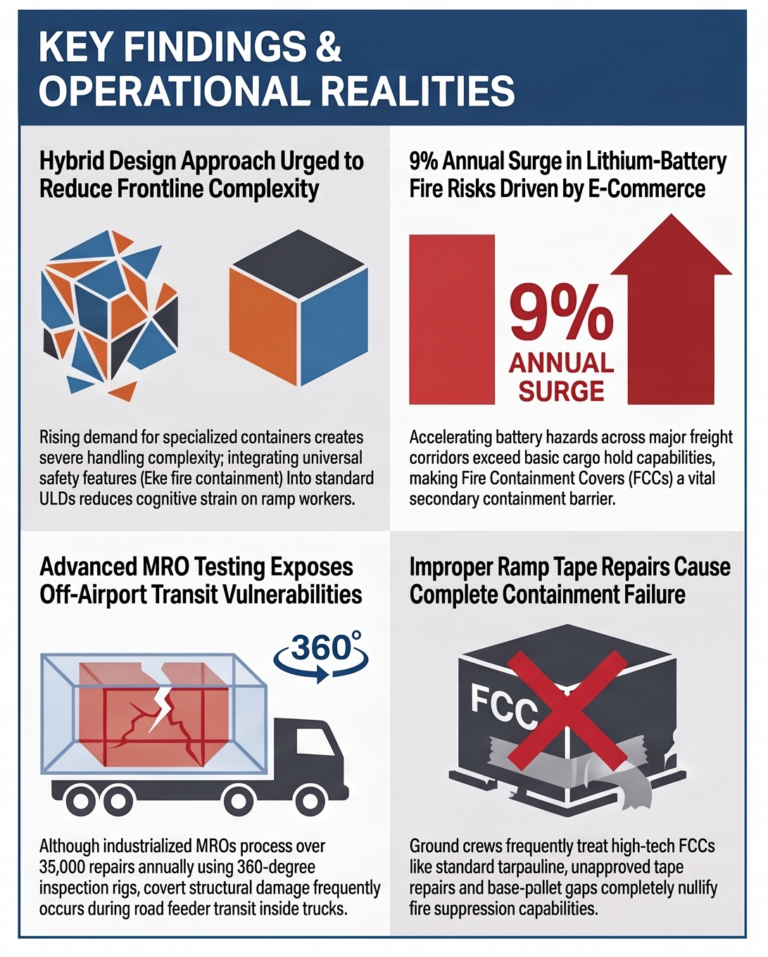
and expensive asset damage. - The Hybrid Consensus: Industry leadership concluded that the solution is a hybrid approach that standardises common special requirements directly into core equipment (such as integrating fire containment features into standard units), thereby reducing frontline cognitive load.
2. Escalating Lithium-Battery Threats & Aircraft Integration
- Surging Fire Incidents: Driven by rapid cross-border e-commerce expansion across China, Europe, and US lanes, lithium-battery fire incidents are escalating at 9% annually, posing risks that outstrip the certification design limits of standard aircraft cargo holds.
- Complementary Safety Layer: Aircraft manufacturers such as Airbus consider FCCs essential secondary protection alongside onboard detection and suppression systems.
- Emerging Technologies: Airbus is pursuing a dual approach:
– upgrading fire-retaining cargo hold liners
– investing in early AI-based thermal runaway detection,
while anticipating future hazards like electric vehicle (EV) battery transport and automated onboard suppression.
3. Maintenance Realities & Frontline Indiscipline
- Industrialised MRO: Maintenance providers are adapting to the vulnerabilities of textile covers. TotalX highlighted its dedicated 600 m² facility repairing over 35,000 FCCs annually, bringing turnaround down to 2.2 man-hours per unit.
- Advanced Inspection: A specialised 360-degree inspection rig that simulates FCCs in their deployed state is now being shared with airlines to perform dependable pre-flight checks.
- Field Vulnerabilities: Substantial FCC damage occurs during off-airport trucking and road transport. Crucially, improper ramp workarounds—such as using adhesive tape for field repairs or leaving gaps at the pallet base—completely compromise and nullify fire containment apabilities.
4. Training Deficits & Lifecycle Data
- Conventional Handling of Critical Assets: Ramp personnel frequently handle high-cost FCCs like basic tarpaulins due to a lack of awareness regarding damage tolerance and airworthiness stakes.
- Data Ecosystem Gaps: Effectively managing specialised containers requires data exchange beyond basic ULD Control Messages (UCMs) to include freight forwarders and cargo brokers across the full asset lifecycle.
Action Items & The Industry Roadmap
To translate these findings into standard operating practices, the working groups established the following clear action items:
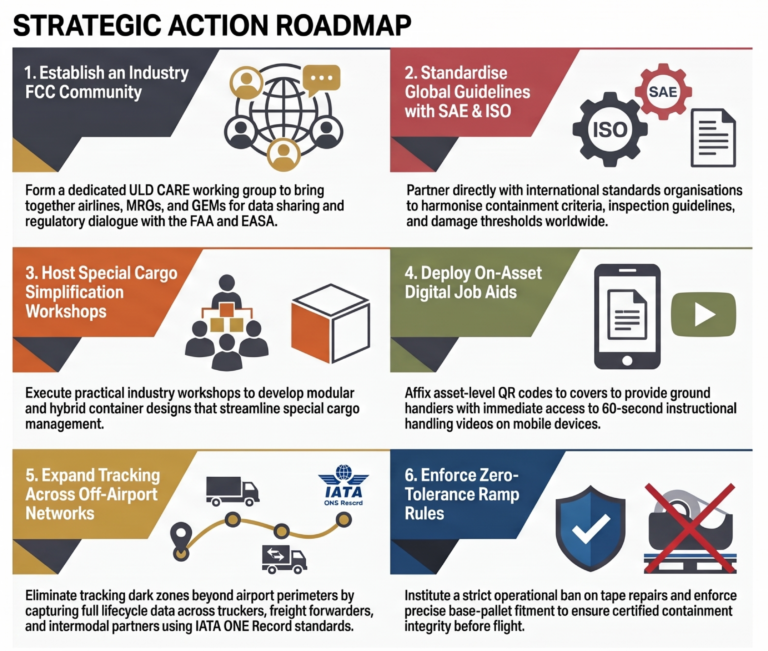
- Establish an Industry “FCC Community”:
ULD CARE will convene a dedicated multi-stakeholder FCC group comprising airlines, OEMs, and MROs to share transparent, multi-party damage data, isolate root causes, and provide empirical guidance to civil aviation regulators (FAA and EASA). - Standardise and Harmonise Global Guidelines:
Partner with international bodies (SAE and ISO) to establish harmonised damage limits, operational benchmarks, and standardised handling procedures
across manufacturers and carriers. - Facilitate Special Purpose Simplification Workshops:
ULD CARE is tasked with holding focused technical workshops to design simplified, multi-use special cargo containers and evaluate universal labelling
standards. - Deploy Digital Job Aids & Instant Training:
Transition from generic checkbox learning to practical, competency-based instruction, introducing on-asset QR codes linking directly to 60-second handling videos and deployment instructions for ramp staff. - Expand Off-Airport Data Tracking:
Broaden the digital tracking ecosystem to capture custody handoffs with truckers and forwarders, addressing transit damage that occurs inside trucks and reducing repositioning friction. - Enforce Zero-Tolerance Ramp Procedures:
Eliminate dangerous improvisations—specifically banning tape repairs on fire covers and enforcing tight base-pallet fitments to preserve fire containment integrity.