AI & Digitisation Track at ULD CARE 2026
Unlocking the Digital Future: AI, Shared Data, and Smarter ULD Operations
1. Overview of the AI & Digital Track
The digital track at the 2026 ULD CARE Annual Conference in Athens addressed a fundamental challenge across the air cargo supply chain: while unit load devices (ULDs) represent critical operational and flight-safety assets, digital adoption remains fragmented across corporate silos. The track brought together airlines, pooling operators, ground handling agents (GHAs), original equipment manufacturers (OEMs), and digital solution providers to bridge the gap between emerging artificial intelligence technologies and daily ramp realities.
Rather than pursuing theoretical technology demonstrations, the track focused on practical implementation: establishing trusted data foundations, defining a five-year modernization window, establishing safety as the industry’s "North Star" metric, and leveraging neutral governance through ULD CARE and open standards like IATA ONE Record.
2. Plenary Panel Session: Digital Future, Tracking, and AI
Moderator:
Gert Pfeifer (Jettainer)
Panelists:
Owen Martin (ULDigital / ULD CARE Digital Ambassador)
Kathanyu Jearachaikul (Unilode Aviation Solutions)
Carsten Hernig (PACTL)
Jennifer Horton (AviusULD)
Andreas Baumann (Jettainer)
Abedin Dula (SkyCell)
Core Themes & Discussion Summary
Safety as the Industry's North Star
The panel rejected abstract tech hype, establishing that AI adoption must directly serve operational safety and risk mitigation. Priority areas include preventing container collapse, eliminating ramp damage from forklift impacts, safeguarding lithium battery transport, and ensuring flight airworthiness.
The 5-Year Window & Data Foundation Imperative
Citing macro analyses from McKinsey and IBM, the panel emphasised that advanced AI tools—especially autonomous, multi-step "agentic AI"—cannot function without complete, clean, timely, and consistent operational data. Currently, only 30% to 40% of the global fleet of 1.0 to 1.2 million ULDs carries digital tracking devices. Achieving meaningful predictive modelling and automated logistics requires crossing an industry threshold of 75% to 80% data coverage within a critical five-year technology cycle.
Overcoming "POC Fatigue" with a Problem-First Approach
Unfocused "proof-of-concept" (POC) trials and uncoordinated vendor pilots have diluted industry momentum. Panelists called for a strict "problem-first" methodology that identifies operational bottlenecks, quantifies financial return (such as dwell-time reduction), and enforces short 3- to 6-month agile sprints that can iterate or fail quickly.
Ground-Level Visibility & Handoff Accountability
Pervasive asset loss and structural damage stem from a lack of mutual accountability at intermodal transfer points. Operators routinely deny responsibility when custody changes between airlines, GHAs, truckers, and freight forwarders. The panel advocated for verifiable, low-friction handoff solutions, such as smartphone optical character recognition (OCR), writeable RFID tags, and automated photo condition logging at origin and destination.
Closing the OEM Feedback Loop
OEMs currently design equipment without structured field performance feedback, relying instead on sporadic verbal complaints. An anonymised data-sharing layer will provide manufacturers with empirical telemetry on operational damage mechanisms, wear patterns, and scrapping causes, driving improved ergonomics, lighter materials, longer asset lifecycles, and predictive spare parts forecasting.
Democratising Frontline Knowledge
Given high turnover and multilingual workforces on airport ramps, traditional training manuals often fail to change behaviour. AI offers the capability to convert dense technical manuals into instant, multilingual guidance, interactive microlearning video snippets, and computer vision tools capable of identifying container defects directly from mobile snapshots.
3. Workshop Deliverable: The Air Cargo Data Sharing Framework
Facilitated by Owen Martin on Day 2 of the conference, the interactive working session translated panel concepts into a concrete operational initiative:
Air Cargo Data Sharing.
The resulting framework introduces an industry-level, anonymised data layer managed by ULD CARE as a neutral clearinghouse, creating value across three core stakeholder groups:
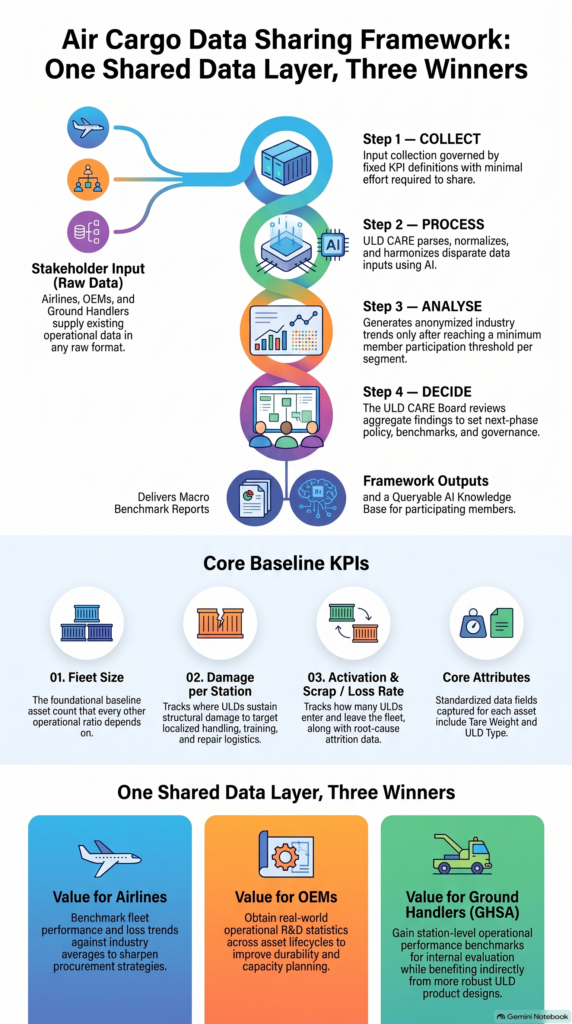
One Shared Data Layer, Three Winners
Airlines: Benchmark internal fleet performance against global trends, pinpoint systemic losses, and refine equipment procurement strategies.
OEMs: Obtain real-world operational R&D statistics, evaluate durability across container types, and enhance manufacturing capacity planning.
Ground Handlers (GHSA): Access comparative performance benchmarks across handling stations and benefit indirectly from more durable, ergonomic equipment.
The 4-Step Minimum Viable Product (MVP) Strategy
To build trust and eliminate onboarding friction, the workshop designed an MVP approach ("Collect First, Decide Next"):
Collect: Participants submit existing records in any raw format, governed strictly by fixed KPI definitions.
Process: ULD CARE uses AI to parse, normalise, and harmonise disparate data feeds into a unified schema.
Analyse: Data is strictly anonymised, with aggregate trends published only after meeting a predetermined minimum member participation threshold per segment.
Decide: The ULD CARE Board reviews preliminary findings to ratify permanent governance and reporting cadences.
The Three Core Baseline KPIs
Instead of demanding complex operational integration, the initial data collection focuses on three fundamental metrics:
1. Activation & Scrap / Loss Rate: Tracking asset fleet entry and attrition volumes, along with root-cause indicators.
2. Damage per Station: Mapping incident frequencies across specific ground stations to target handling training, infrastructure maintenance, and repair logistics.
3. Fleet Size: Establishing the baseline asset count against which all operational ratios, dwell times, and loss metrics are calculated.
Core Data Attributes: Tare weight and standard ULD type.
4. Strategic Actions & Execution Roadmap
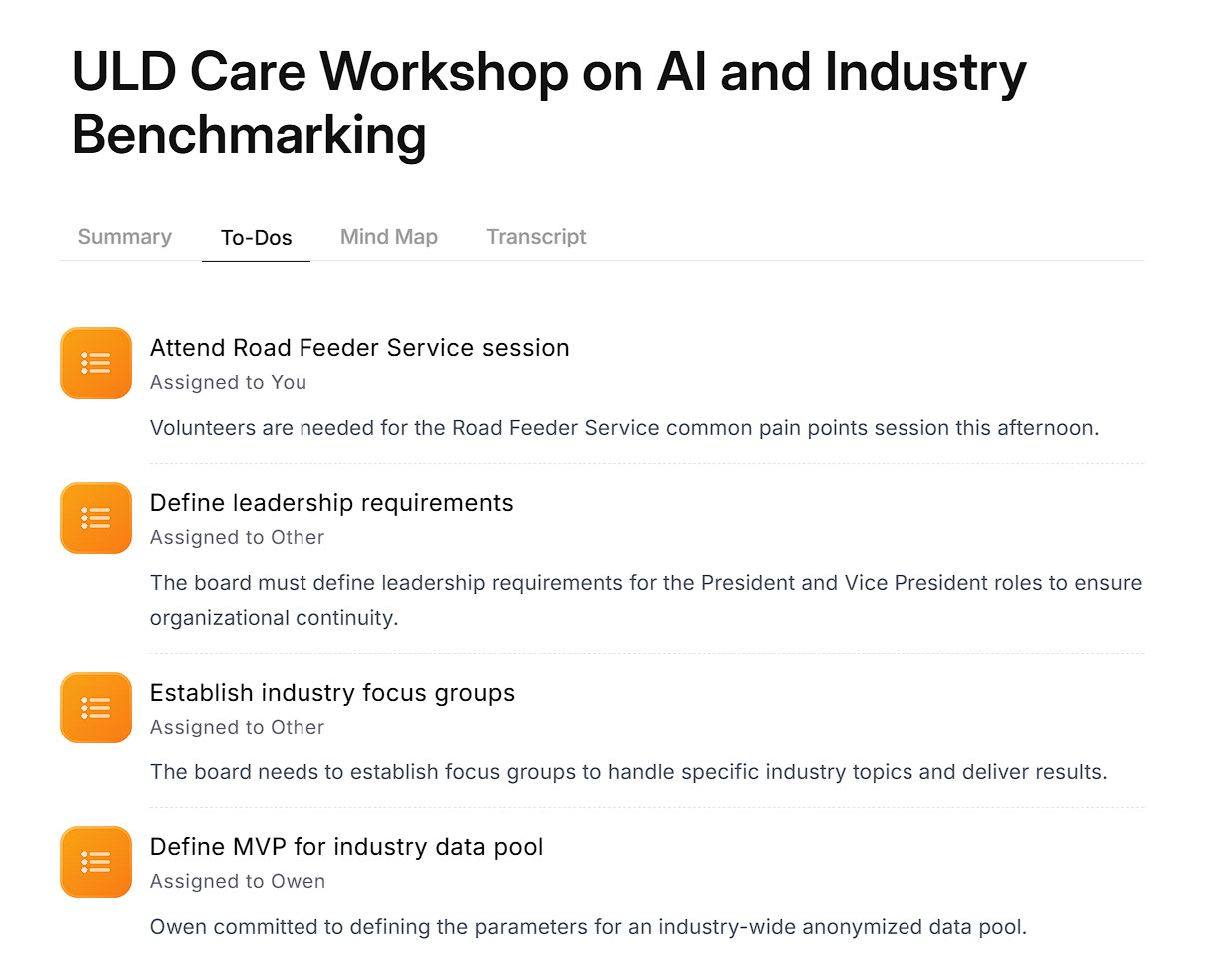
The combined outcomes of the moderated plenary, board governance reviews, and the technical workshop established an integrated schedule of action items across governance, technical delivery, and community engagement.
A. Workshop & Data Initiative Actions
MVP Scope
Definition
Define final parameters, attributes, and submission formats for the initial data collection.
Working Group Lead / Board
Immediate Priority
Formal Member Data Call
Issue a standardised request to airlines, OEMs, and handlers to submit baseline anonymised fleet data.
Working Group Lead
Q4 2026
First Benchmark Report
Normalise member submissions using AI and publish the initial anonymised industry benchmark report.
Working Group Lead
Q1 2027
Platform Value Proposition
Draft a formal business case outlining commercial value, demurrage reduction, and safety impacts.
ULD CARE Management
In Progress
Funding & Levy Strategy
Model a sustainable financing structure (such as a development levy or freemium membership tier) to support ongoing AI platform costs.
ULD CARE Board
Q4 2026
B. ULD CARE Strategic & Board Deadlines
25 October 2026: Finalise organizational strategic direction and non-airline value proposition.
28 October 2026: Review annual conference outcomes and formally approve working group goals.
8 November 2026: Complete functioning prototypes for AskULD AI enhancements, including multilingual Q&A and image-based container damage identification.
15 November 2026: Document tiered commercial membership value models.
22 November 2026: Finalise the monetization and rollout plan for digital operations tools.
25 December 2026: Ratify new agile board and working group governance structures.
31 January 2027: Publish standardized operating procedures (SOPs) for non-airline members.
C. ULDigital Technical Execution Milestones
Q1 2026 – Mobile Condition Capture: Exploration and rollout of Option B smartphone OCR frame reading for instant ULD identification.
Q2 2026 – Writeable RFID Integration: Deployment of Option A writeable RFID integration for Android handhelds, initiating field CapEx protection trials.
Q3 2026 – Predictive Dwell Alerting & Open APIs: Implementation of off-airport predictive dwell alerts and the launch of the Intermodal Open API Gateway ('Ping & Proof' loop).
Q4 2026 – White-Label Verification Engine: Unlocking white-label e-UCR eVerify capabilities for native integration into airline and logistics IT suites.
5. Get Involved
Building an illuminated, digitally connected supply chain requires active participation from all ecosystem partners.
Join the 2026–2027 Digital AI Working Group:
Participate directly in standardizing data dictionaries, refining KPI benchmarks, and evaluating real-world pilots.
Contribute to the Data MVP:
Support the industry baseline by submitting anonymised fleet, station, and loss figures to ULD CARE.
Contact:
Connect with the ULD CARE digital transformation committee to register your organisation’s interest.