
Executive Brief
In the global air cargo network, interline agreements expand carrier reach but introduce severe asset management vulnerabilities. When a Unit Load Device (ULD) transfers custody from one airline to another during an inter-carrier handoff, it crosses organizational and liability boundaries. Without rapid, reliable receipt logging, hundreds of pallets and containers are lost daily, resulting in millions of dollars in annual replacement capital expenditure, lease penalties, and operational delays. The e-UCR mobile application, integrated with the eVerify validation framework, provides an immutable digital handoff mechanism that secures asset custody, eliminates disputes, and protects fleet value at the exact second of transfer.
Ramp Reality & Operational Context
The air cargo ramp during peak operations is a harsh, high-velocity environment. Historically, interline transfers relied on physical, carbon-copy ULD Control Receipt (UCR) paper forms. These paper documents are frequently lost, damaged by weather, or left blank by hurried ground handlers. Air cargo containers and pallets never carry paper shipping labels or adhesive stickers due to flight safety regulations, and they do not utilize standard IATA frame text / RFID tags / Mobile OCR natively.
Instead, assets must be identified by their permanent, unique ULD ID number engraved into their aluminum frames. Under legacy workflows, handlers must manually transcribe these 10-character codes under poor lighting or adverse weather. This leads to high typing error rates, unlogged transfers, and a complete lack of proof regarding which carrier had custody when damage occurred or when an asset went missing.
Dual Execution Architecture
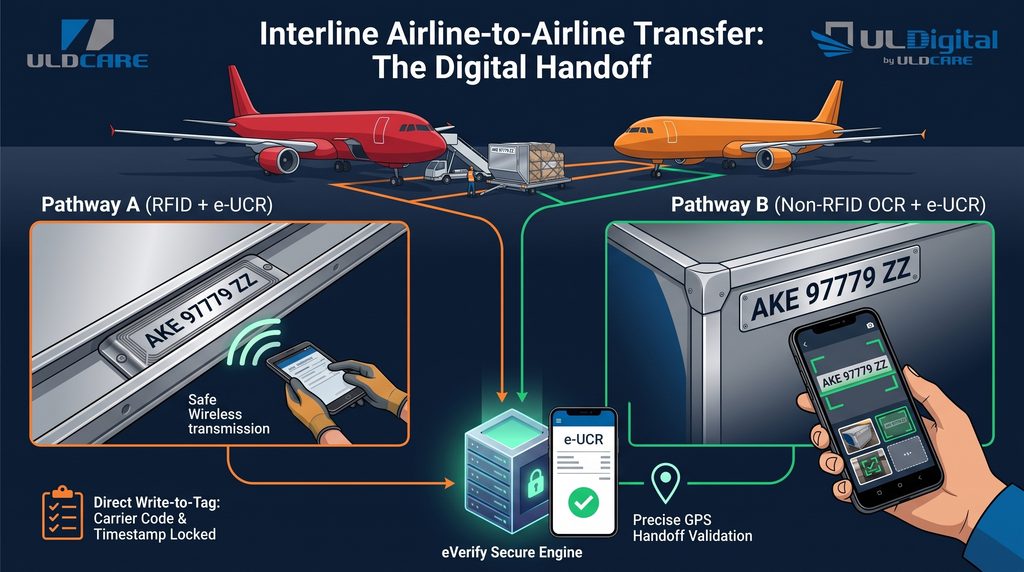
Option A: Writeable In-Rail RFID
- Handoff Initiation: Transferring carrier delivers loaded/empty pallet to receiving airline’s transfer zone.
- Direct Write-to-Tag: Ground handler approaches pallet with a rugged Android mobile device running e-UCR.
- Data Encoding: Close-range RFID writer writes receiving carrier code, station code, & timestamp to physical In-rail chip.
- Condition Capture: Handler captures up to 4 quick photos documenting structural condition.
- eVerify Validation: Transmits transaction to eVerify cloud, logging GPS coordinates & closing outbound log.
- Offline Resilience: Saved locally and on chip if network is unavailable; auto-syncs when reconnected.
Option B: AI OCR Scan
- Camera OCR Scanning: Handler points smartphone/tablet camera at engraved aluminum ULD ID plate.
- AI Text Extraction: Integrated OCR extracts 10-character ID despite dirt, scratches, or low light.
- Condition Capture: Handler captures up to 4 quick photos documenting structural condition.
- Digital Logging & GPS: eVerify registers transaction with exact time-stamp and live GPS coordinates.
- Direct Sign-Off: Transferring handler signs touchscreen, instantly generating paperless e-UCR.
Financial & Operational Impact Matrix
| Impact Pillar | Operational Shift | Financial & Strategic Impact |
| 1. Custody Dispute Resolution | Paper trails → GPS-stamped, eVerify digital transactions | 90% reduction in dispute resolution hours; saves up to $150,000/yr in labor for mid-sized hubs. |
| 2. Lost Asset Mitigation | Real-time custody tracking prevents ‘black hole’ losses | 15% to 25% decrease in annual ULD replacement capital expenditure. |
| 3. Paper Elimination | 100% digital electronic receipts replace 3-part carbon paper | Eliminates printing, courier & manual scanning; saves ~$2.50 per transaction. |
| 4. Ramp Velocity | Manual serial typing → instant OCR / RFID scan | Processing time drops from 6 min to <30 sec; avoids flight delay penalties. |
| 5. Damage Accountability | Mandatory photo capture (Opt B) & timestamped custody logs | Shifts repair costs to liable party; saves $100k+ in unjust maintenance bills. |
| 6. Audit Readiness | Disorganized paper binders → cloud digital database | Guarantees 100% IATA compliance; eliminates safety violation fines. |